Bounce
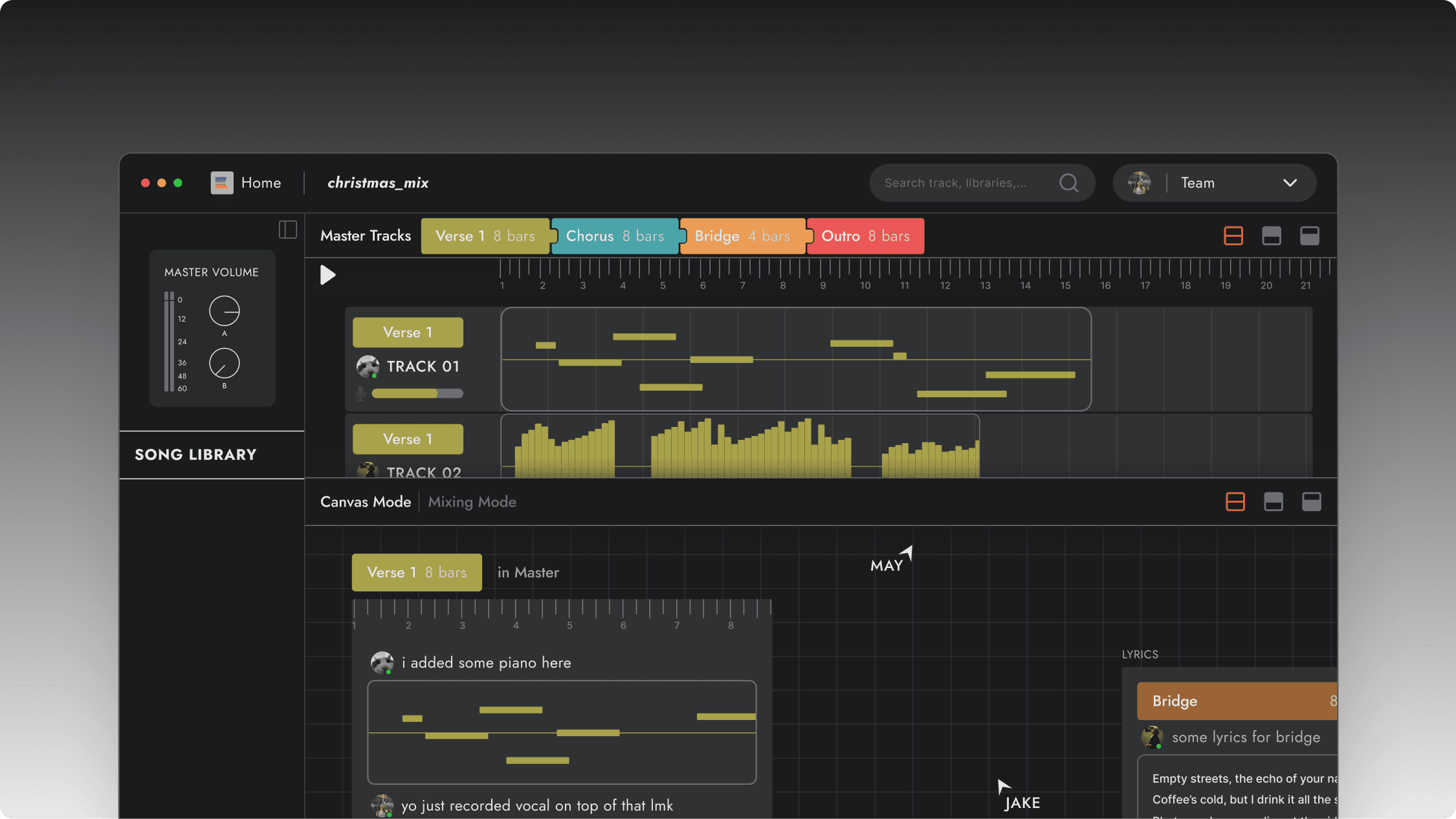
Designed a new take on DAWs to support remote music collaboration.
Timeline
4 months (Aug – Dec 2025)
Role
Solo Product Designer
Outcome
Designed a new take on DAWs to support remote music collaboration.
Overview
What are Digital Audio Workstations (DAWs)?
DAWs are industry-standard softwares for producing music. Common functionalities for DAWs include but not limited to recording, editing or mixing a piece of music.
Examples of DAWs, from left to right: Logic Pro – Ableton – Pro Tools
Problem
Built only for solo work
Being a musician, I notice that music is a greatly collaborative process. However, DAWs have been built for solo work since the day it was being invented til today.
As designers have Figma, engineers have GitHub and AI workflows, I and my fellow musicians have been longing for a digital solution to this ancient collaboration problem:
What if there is a DAW that supports music professionals and hobbyists in remote collaboration while keeping its complex functionalities?
Solution highlights
Defining the Problem
Understanding the producing process & current DAW usage behaviors through surveys and interviews
To investigate my hypothesis, I conducted a quantitative survey with 10 professional musicians and producers (5-10 years of experience) with follow-up in-depth interviews.
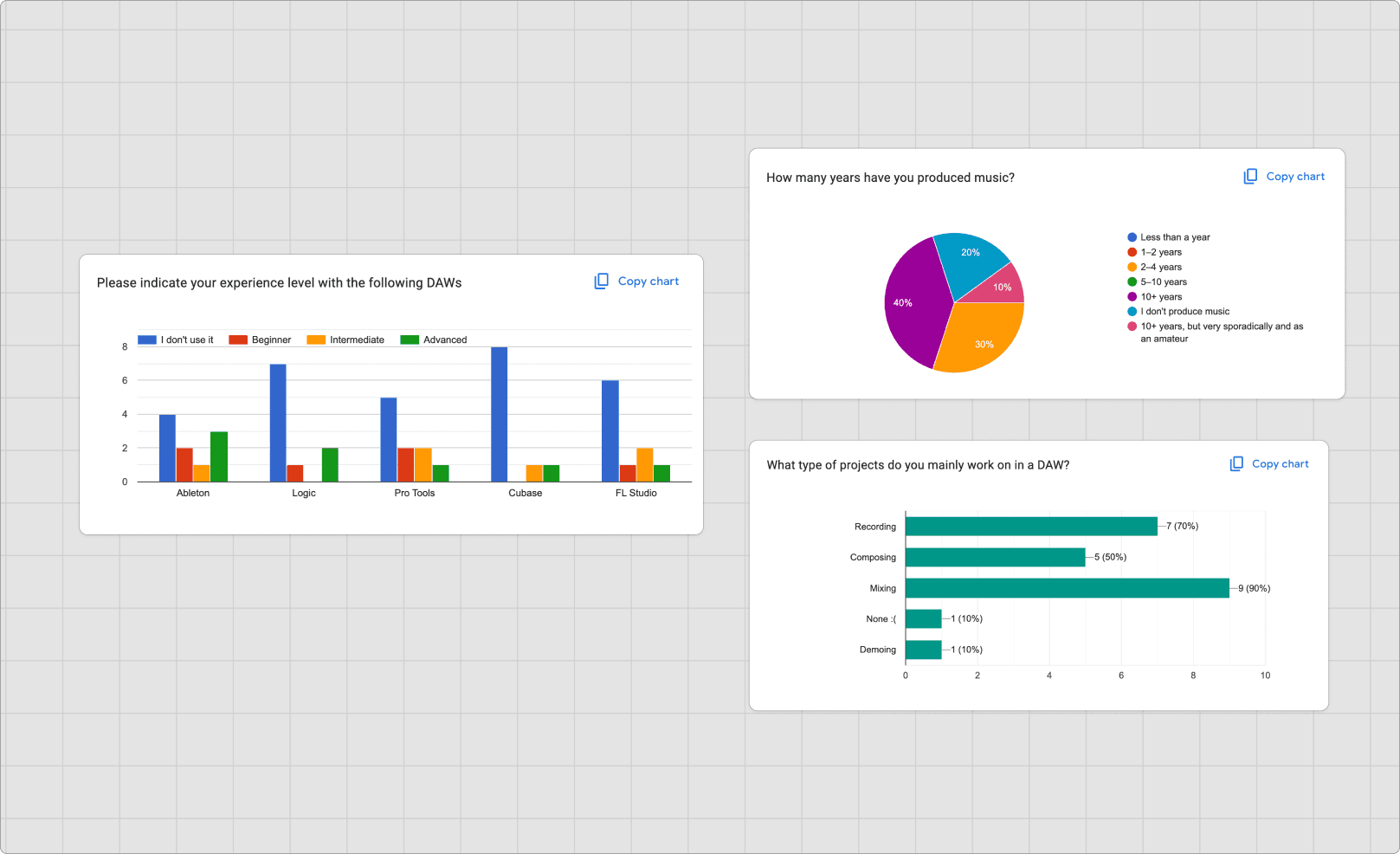

Insight #1 — Tedious Collaboration Process
Sending large files and stems of a single fix is tedious and time-consuming, especially when most of the time the receiver has to realign the new files with their local version manually.
Going back and forth like that, especially in different time zones, is so tedious. I think this is why people still prefer to collaborate in person in this digital age.
Insight #2 — Lack of support for musical discussion
Musicians often use onomatopoeia such as 'ooh' and 'tsk' to convey musical ideas to each other. There are no direct support for this form of communication digitally.
Ideating is a very vocal process, so having a way to call and make conversation in real time will boost collaboration.
Insight #3 — No true mastery of the tool
Sound engineering is a hard discipline on its own, but often times these engineers still need to adapt to DAWs custom plugins and troubleshooting system on the side. DAWs are hard to learn for both professionals and beginners, even if they already spend 10,000 hours on it.
After all these years, I still don't know what I'm doing.
Refined HMW questions
- How might I support direct file and version management in DAWs to help alleviate time cost for sound engineers and producers?
- How might I make remote music collaboration in DAWs feel as natural and expressive as being in the same room?
- How might I help musicians of all levels adapt to DAWs quickly?
Notable Iterations
Notable Iterations
Maximizing focus by abstracting workflows
In the quest of challenging the traditional DAW interface pattern to replace with a more intuitive one, I separated production apart from post-production. This created the challenge of connecting them together while keeping complex functionalities intact. The final 3 modes proved to be more intuitive for seeing this connection.
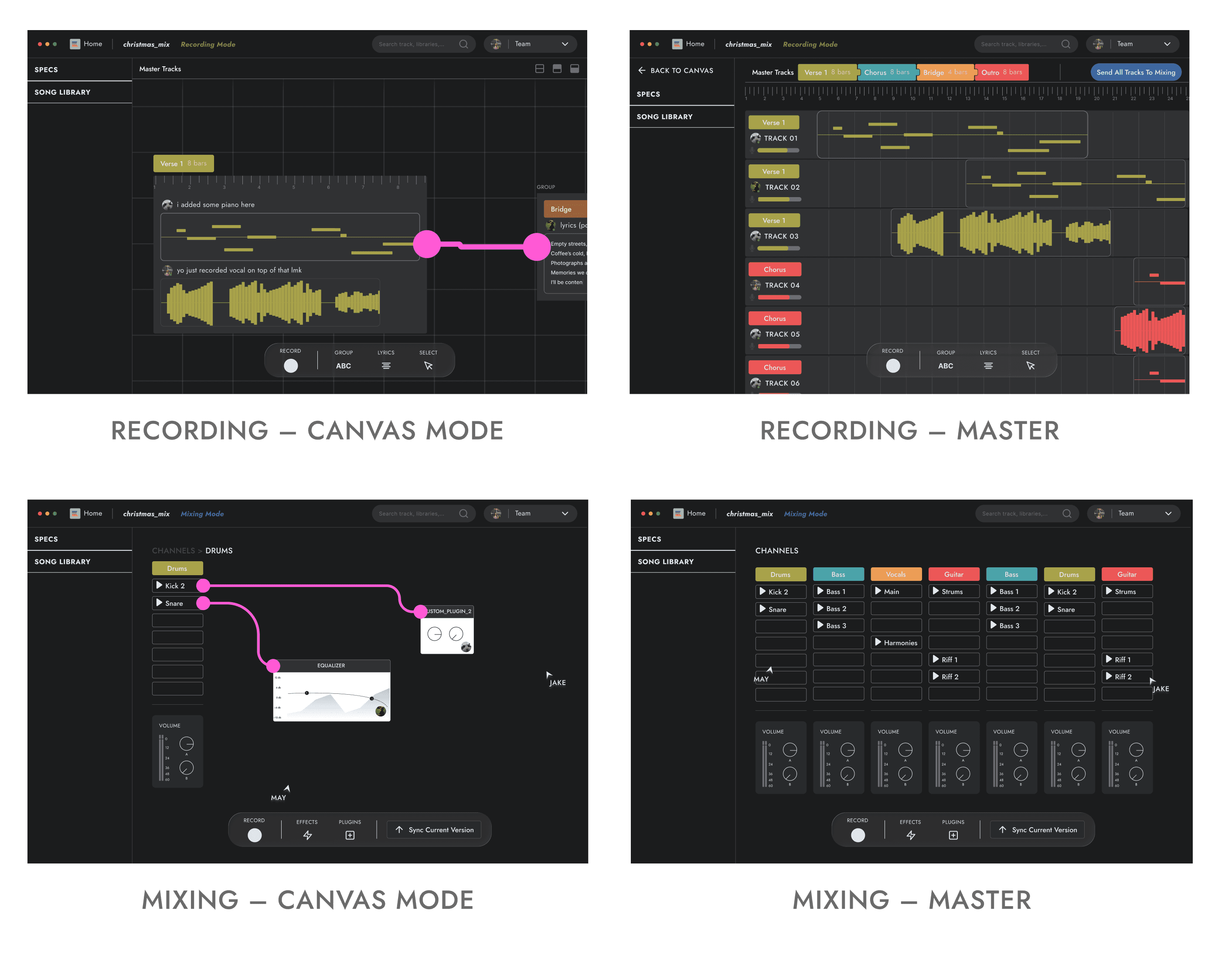
Before: 4 screens for 4 modes, too complex
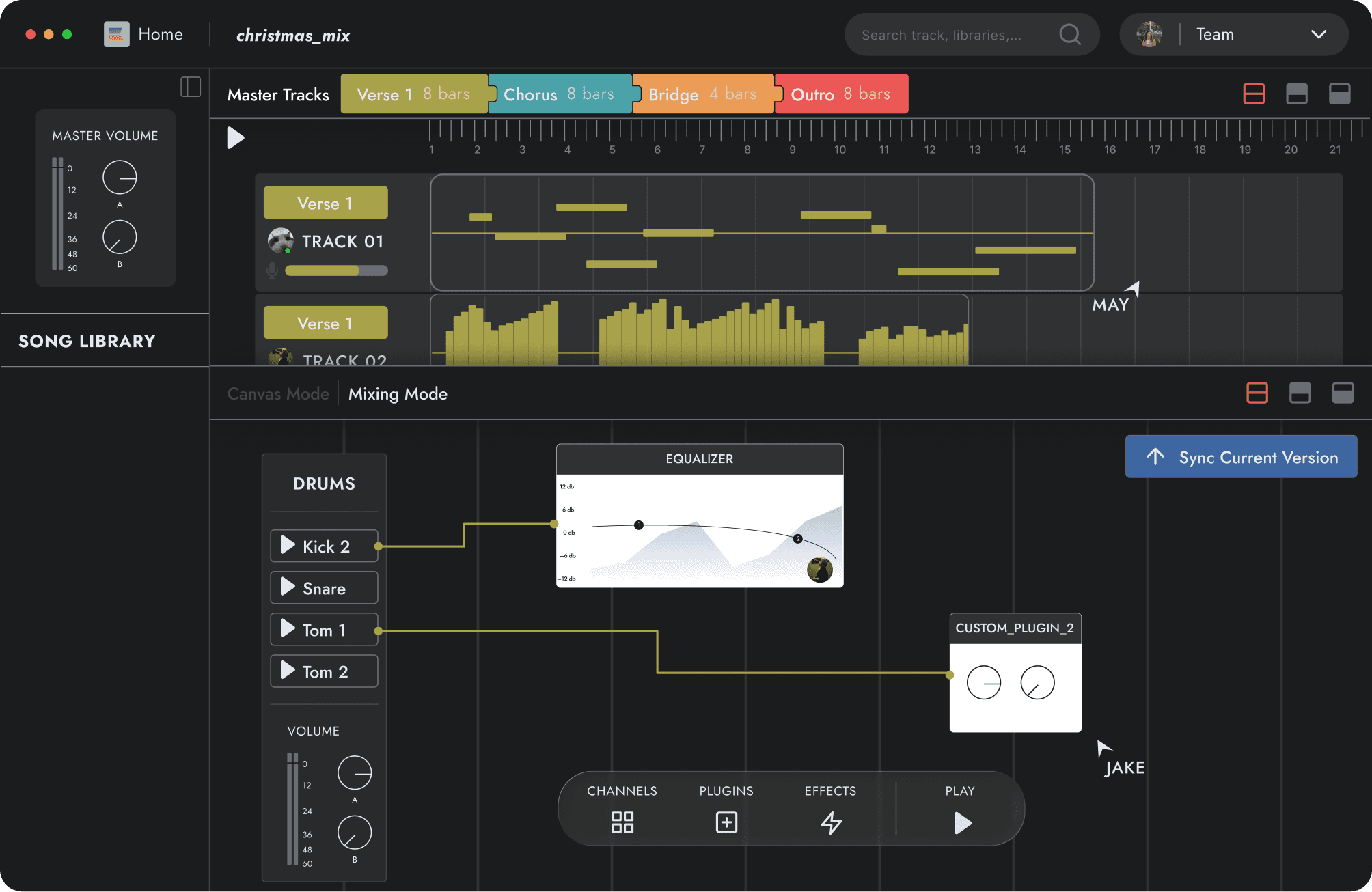
After: 1 screen for 3 modes, simple
Communication channel
Placing communication in the top right corner instead of left proved to be more discoverable to users through testing. Additionally, improvements in labels ('Jam' to 'Teams') and visual nature of the components (fixed vs. floating) added to discovery and utility success rate.
Before: fixed comms bar and vague language

After: flexible position and intuitive language
Toolbar
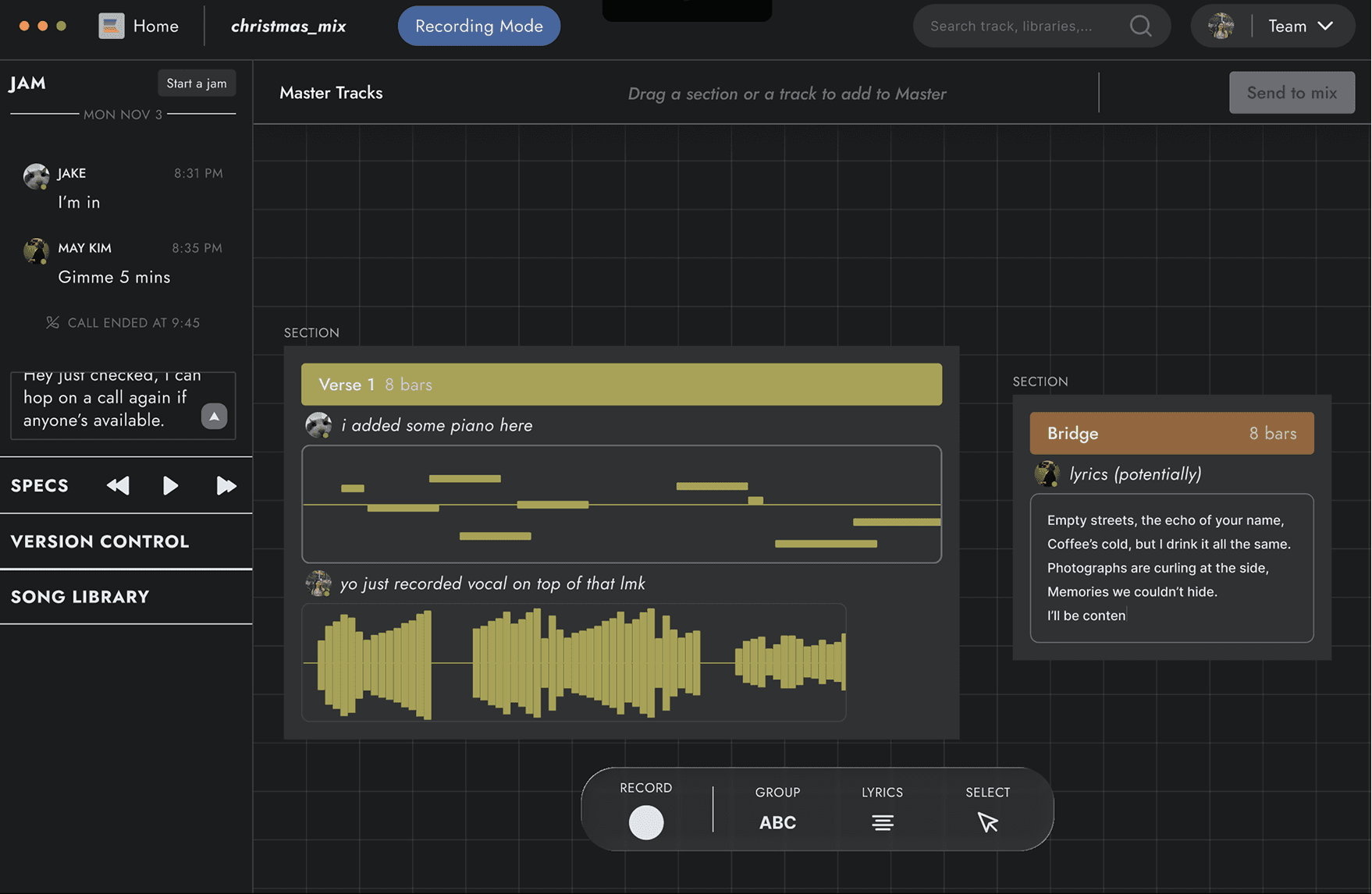
From testing, I refined the information displayed in the toolbar for each mode: recording and mixing, so that only necessary functions remain. Final: essential information only — Recording, Group, ABC/Lyrics, Select (Recording Mode) | Recording, Plugins, Effects, Sync Current Version (Mixing Mode).
Style Guide
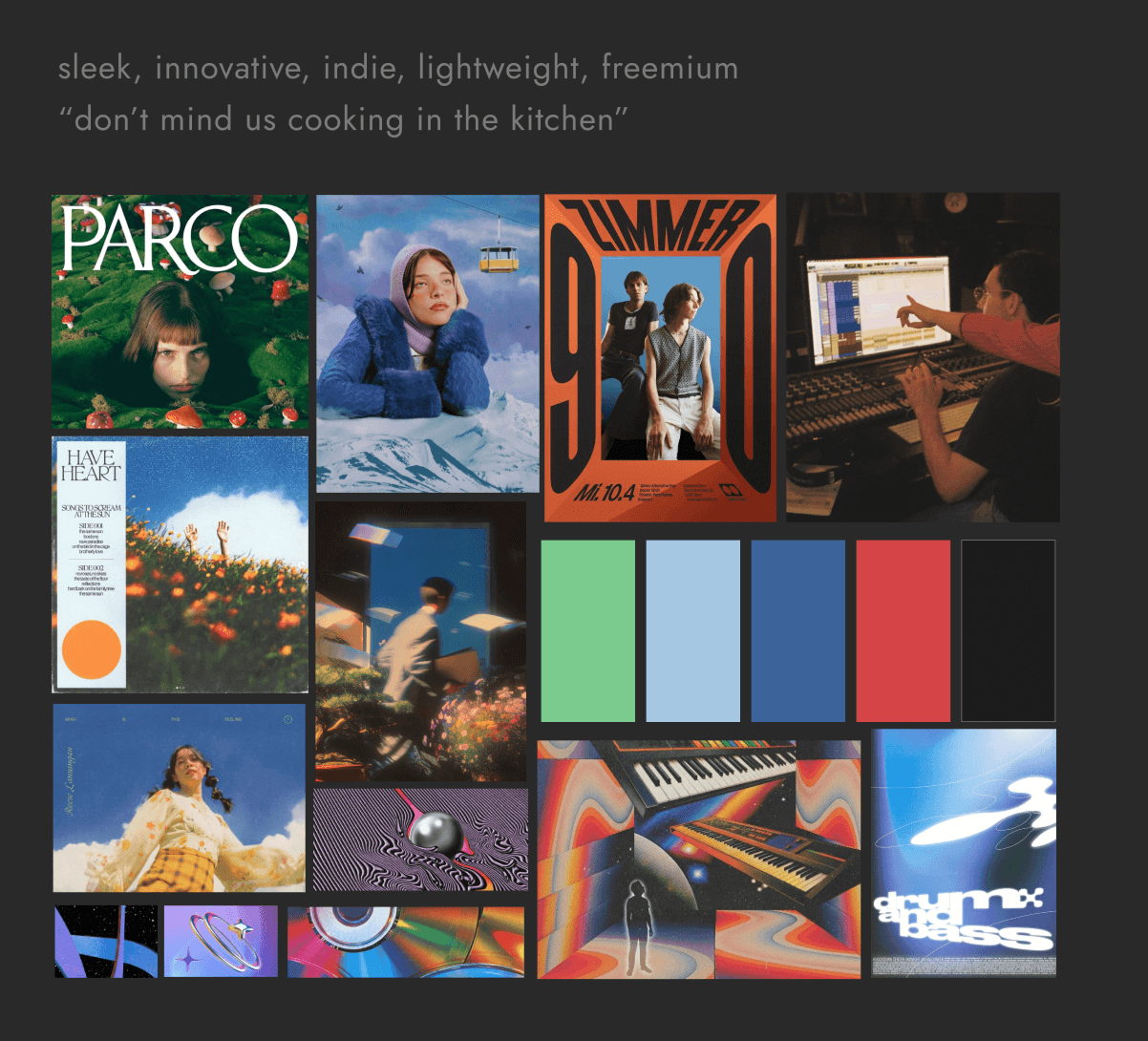
An indie and nostalgic ecosystem
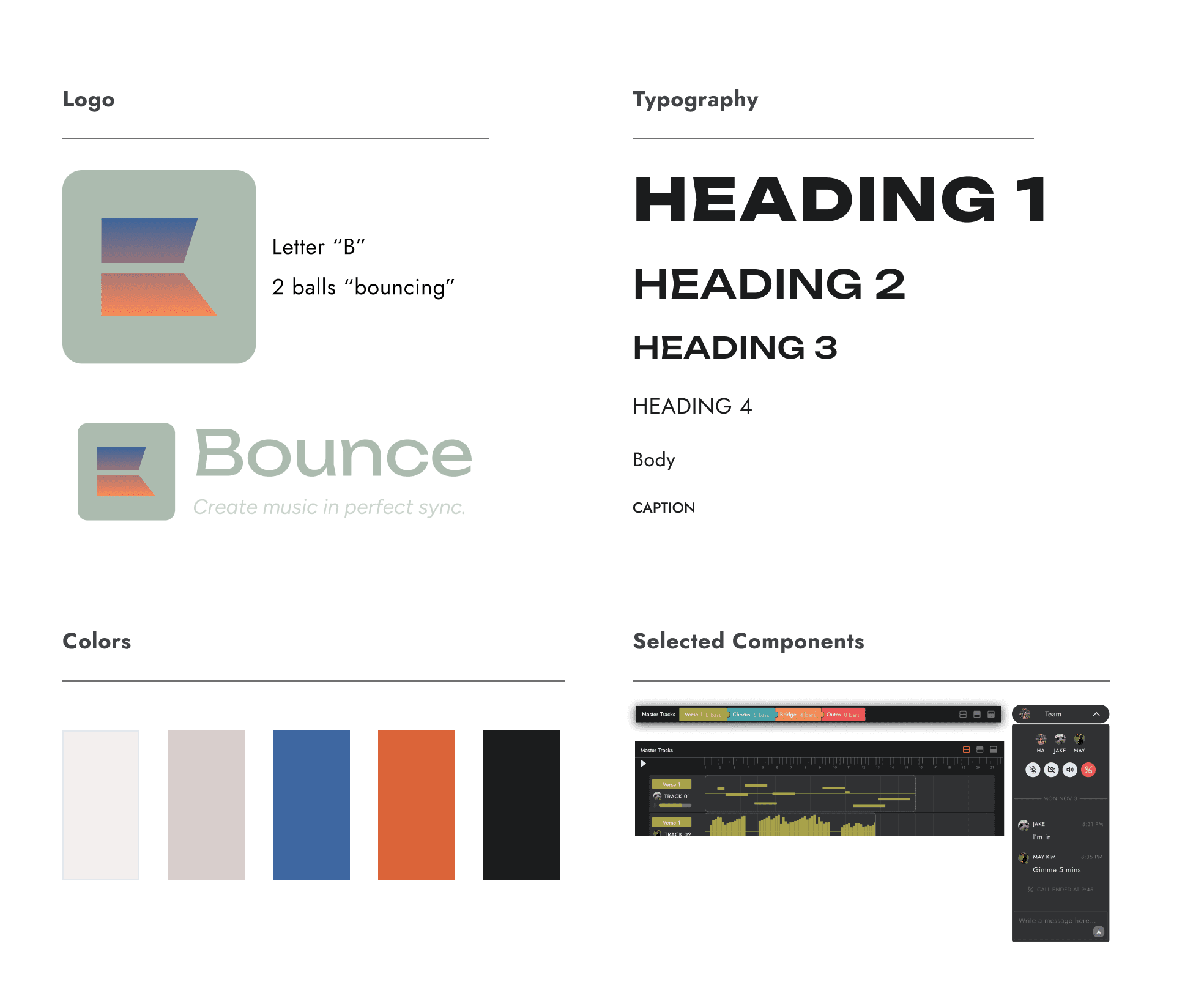
I take inspirations from the feeling of the 'zone' – how we can get lost in the process of making music. I gravitated towards the indie, ethereal vibe to remind users that Bounce is for bouncing human ideas. Additionally, I took the name 'Bounce' from the common DAW button label when exporting the final product, and the act of 'bouncing' ideas off of each other.
Final Designs
Final Designs
Elaborated MVP for music collaboration
3 different views allowing focusing on different tasks with flexible panels
Real-time chat, call and video call while working on production
Recording and composing a new song
Quickly put down a musical idea with teammates to canvas with no time restrictions
Add effects and plugins as nodes for troubleshooting semantic audio issues (mixing post-production)
Upload local changes to the shared cloud for mutual access to the latest version (version control)
Results
“Would absolutely use this for my producing work, and excited to see what comes next for Bounce!” — a guitarist/producer after testing
“So exciting…this reminds me of a physical mixing board.” — a product designer and hobbyist producer
Retrospective
Retrospective
Designing a tool for creators requires thinking in meta
It was such a fresh air to take on a challenge of creating something that others use to create with. I learned to consider the stakeholder's stakeholders – how producers would consider their audiences' needs when they produce, and what would they need to get those results. These insights have driven my designs in wonderfully surprising ways!
Abstraction is key to convey complex functionalities
This project has humbled me and pushed me to prioritize the most efficient flows to best illustrate my product. Many details such as building the audio library or bypassing custom plugins needed to be abstracted in order to communicate my core ideas, especially to non-target users.
A solo project, but I was not alone
I am lucky to have received supports and feedback from both of my designer and musician communities in this project. Co-creating a DAW with actual producers has opened my eyes in how I'd approach design – more daring, more innovative, and more human. It has been a rewarding sprint, and I am deeply grateful for every help along the way 💛